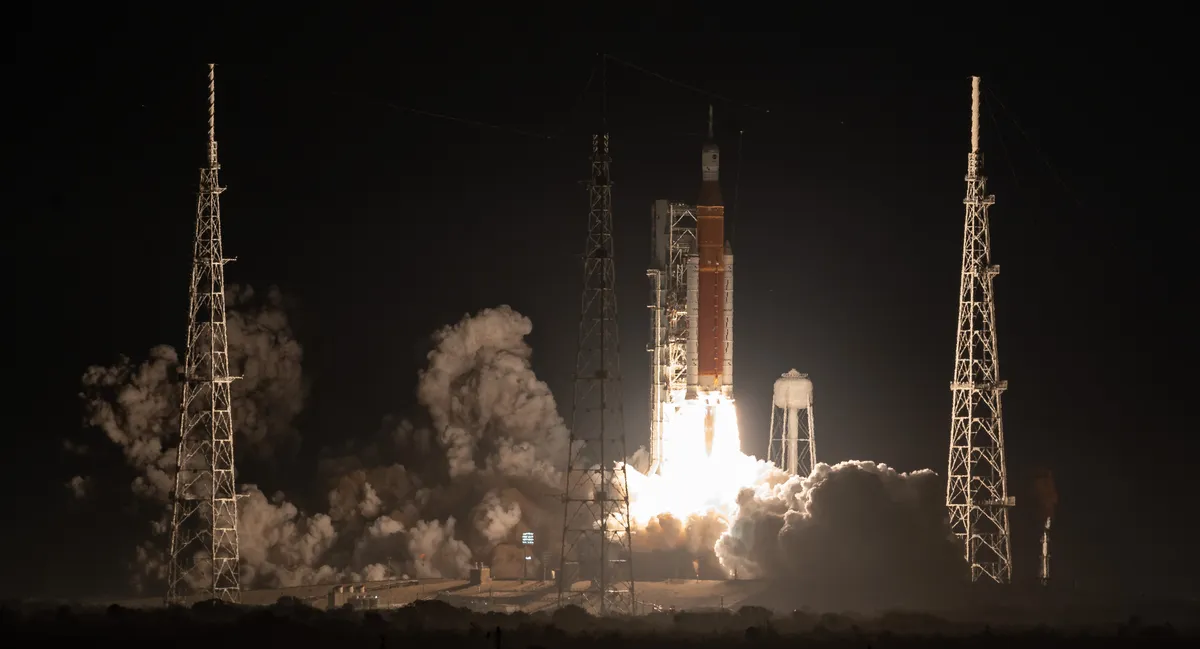
The upcoming NASA Artemis II mission, set to launch on April 1, 2026, represents a pivotal moment in space exploration, marking the first crewed flight beyond low Earth orbit since Apollo 17 in 1972. This mission will not only carry four astronauts—Reid Wiseman, Victor Glover, Christina Koch, and Jeremy Hansen—but also aims to rekindle the global unity inspired by the Apollo 8 mission.
Artemis II will perform a lunar flyby, with a mission duration of approximately 10 days, returning to Earth without landing on the Moon. Utilizing the Space Launch System (SLS) rocket and Orion spacecraft, the mission is poised to set several historic precedents, including the first time a woman, a person of color, and a non-American astronaut travel to the Moon.
NASA has faced numerous challenges, including delays and rising costs, as it relies on private companies for essential components. The Artemis program’s long-term vision includes establishing infrastructure near the lunar South Pole, which is critical for future lunar exploration.
However, the Artemis II mission carries inherent risks. NASA emphasizes that precision and risk management are essential, given the agency’s history of spaceflight tragedies. The untested life support systems and potential solar radiation exposure add layers of uncertainty to the mission’s success.
As the crew prepares for this historic journey, they will face extreme conditions, including re-entry speeds of up to 40,000 kilometers per hour. A malfunction during the mission, millions of kilometers away from the nearest help, would leave the crew with extremely limited options.
NASA has stated it does not plan to perform another Wet Dress Rehearsal (WDR), reducing the number of checks needed before launch. Yet, the launch date remains uncertain due to potential technical issues, and the effectiveness of the untested life support system during the mission is unclear. Additionally, the impact of increased solar activity on the mission is still being assessed.
Details remain unconfirmed, but the anticipation surrounding Artemis II continues to grow as NASA aims to inspire a new generation of explorers.