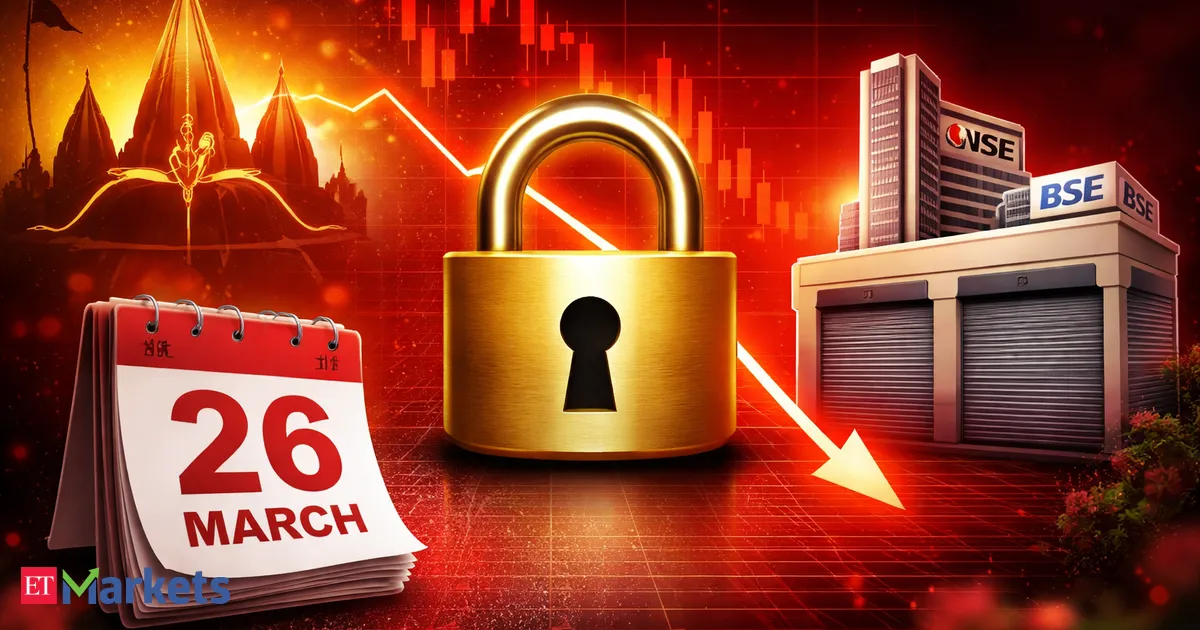
The Indian stock market is experiencing high volatility amid the ongoing US-Israeli war with Iran. In this context, significant stock market holidays are approaching. The Bombay Stock Exchange (BSE) and the National Stock Exchange (NSE) will remain closed on March 26 due to Ram Navami, a major festival in India.
Trading will resume on both the NSE and BSE on March 27, allowing investors to re-enter the market after the holiday. Meanwhile, the Multi Commodity Exchange of India will close its commodity derivatives segment in the morning session on March 26 but will resume trading in the evening.
For 2026, there are a total of 16 stock market holidays scheduled. Following the closure on March 26, the next holiday will be on March 31 for Mahavir Jayanti. Additionally, trading will be suspended on April 3 for Good Friday.
As the year progresses, the Indian stock market will observe several more holidays, including April 14 for Dr. Baba Saheb Ambedkar Jayanti, May 1 for Maharashtra Day, and May 28 for Bakri Eid. The markets will also close on June 26 for Muharram and October 2 for Gandhi Jayanti, with the final holiday of the year on December 25 for Christmas.
Market analysts are closely watching these developments, especially given the recent decline in the Sensex and Nifty, which saw a drop of 7.09% in March 2026. Foreign institutional investors have also been active, with outflows reaching ₹97,000 crore this month and year-to-date withdrawals totaling 1.45 lakh crore.
Despite these challenges, the P/E ratio of Nifty 50 remains at 20x, indicating ongoing investor interest. Observers are keen to see how the market reacts post-holiday, particularly in light of the geopolitical tensions affecting investor sentiment.
As the situation unfolds, market participants are advised to stay informed about upcoming holidays and market conditions. The next few weeks will be critical for assessing the impact of these holidays on trading volumes and market stability.