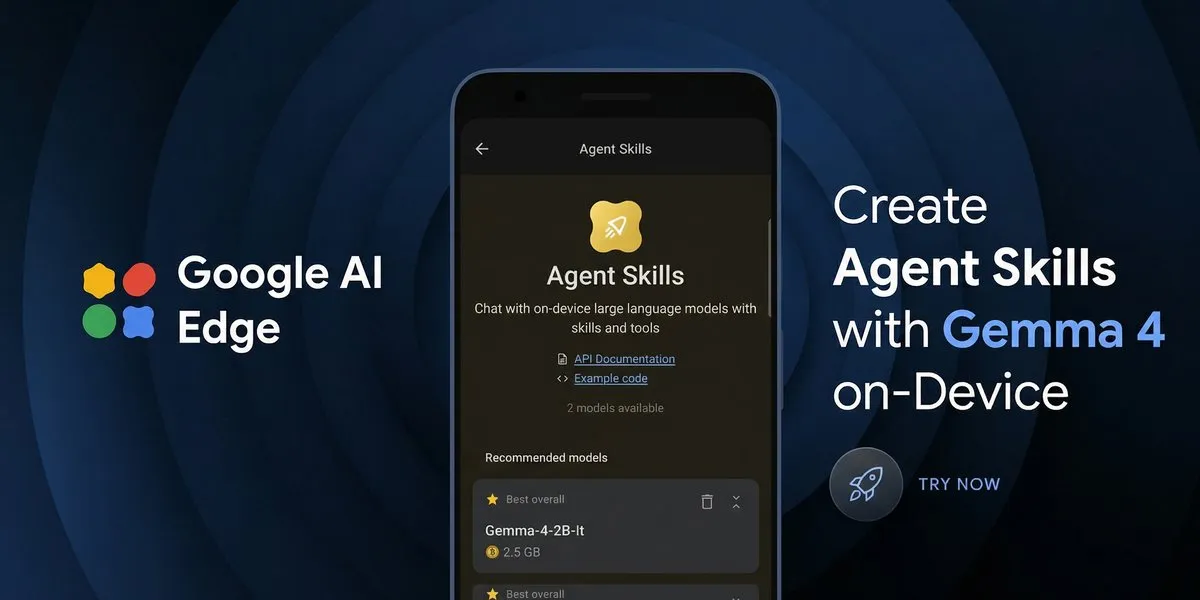
Just before the launch of Gemma 4 AI, anticipation was building in the tech community. Google DeepMind was set to unveil its latest family of models, promising to revolutionize on-device AI capabilities.
On the launch date, Gemma 4 was introduced as a state-of-the-art family of open models, capable of supporting over 140 languages. This significant development marks a milestone in AI accessibility and usability.
Gemma 4 is available under the Apache 2.0 license, allowing developers to freely utilize and modify the technology. This open-source approach is expected to foster innovation and collaboration across various sectors.
The models are equipped with advanced features, including multi-step planning, autonomous action, offline code generation, and audio-visual processing. Notably, the E2B and E4B models support native audio input for enhanced speech recognition.
As of now, Gemma 4 can achieve a prefill throughput of 133 tokens per second on a Raspberry Pi 5, showcasing its efficiency even on lower-end devices. Additionally, the models are optimized for various hardware, from billions of Android devices to developer workstations.
Gemma 4 features a remarkable 128K context window, allowing for the processing of long-form content, which is crucial for applications requiring extensive data analysis.
Moreover, the models include versions sized at 26B and 31B, specifically optimized for different hardware configurations. This flexibility enables developers to build autonomous agents that can interact with various tools and APIs effectively.
The implications of Gemma 4 are significant for developers and researchers alike. As one spokesperson noted, “The era of agentic experiences on-device is here, and we hope you are excited to start building on the edge.” This sentiment reflects the potential for transformative applications across industries.
Furthermore, the ability to generate high-quality offline code positions Gemma 4 as a valuable asset for developers, turning workstations into local-first AI code assistants.
As the technology continues to evolve, the focus remains on empowering users and developers to harness the full potential of AI in their projects. The launch of Gemma 4 AI is not just a technological advancement; it represents a shift towards more accessible and efficient AI solutions.
Details remain unconfirmed regarding future updates and enhancements, but the current capabilities of Gemma 4 AI are already setting a new standard in the field.