Political Landscape Before the Election
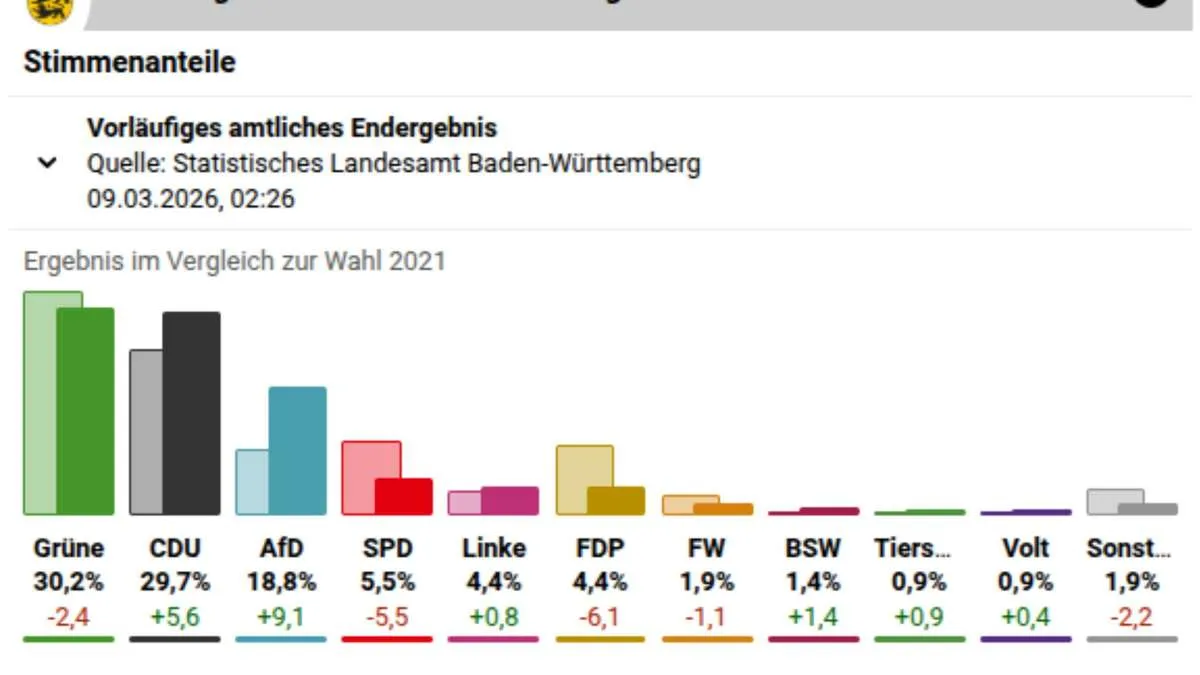
Before the recent developments, the political landscape in Baden-Württemberg was characterized by a strong presence of traditional parties, with the AfD struggling to gain significant traction. The party had previously achieved a modest 9.7% of the votes in the 2021 election, which was seen as a disappointing result compared to its ambitions. The expectation was that the AfD would continue to face challenges in establishing itself as a viable alternative to the long-standing dominance of parties like the Greens and CDU.
A Decisive Moment
The 2026 election marked a turning point for the AfD, as it garnered 18.8% of the votes, reflecting a 9.1% increase from the previous election. This surge in support was significant, positioning the AfD as a potential major player in the Baden-Württemberg parliament. However, despite this electoral success, Markus Frohnmaier, the party’s candidate for Ministerpräsident, faced a critical hurdle: he was not on the ballot for the 7.7 million eligible voters, which meant he could not be elected.
Effects on the AfD and Its Leadership
The immediate effect of the election results was a sense of satisfaction among the AfD leadership. Alice Weidel, a prominent figure in the party, expressed her contentment, stating that the results indicated a doubling of their previous performance. This newfound momentum has led Frohnmaier to extend collaboration offers to CDU’s Manuel Hagel, emphasizing the AfD’s identity as a ‘bürgerlich-konservative Partei’. The party is now poised to become the largest opposition force in the Baden-Württemberg parliament, a significant shift from its earlier positioning.
Expert Perspectives and Context
Experts have noted that the AfD’s rise in Baden-Württemberg is indicative of broader trends in German politics, where right-wing populism has gained traction in recent years. The party’s classification as a right-wing extremist suspect by the Baden-Württemberg Office for the Protection of the Constitution adds a layer of complexity to its political ascent. Frohnmaier’s connections to Russia and his controversial background, including accusations of nepotism regarding his wife’s employment, further complicate his and the party’s public perception.
Frohnmaier’s Background and Political Journey
Markus Frohnmaier, born in Romania and adopted by a German couple, has been a Bundestag member since 2017. His rise within the AfD has been marked by his role as deputy chairman and foreign policy spokesperson for the party faction. As a co-founder of the now-dissolved AfD youth organization Junge Alternative, Frohnmaier has been a significant figure in shaping the party’s direction and appeal to younger voters.
Future Implications
The implications of the AfD’s electoral success are profound, not only for the party but also for the political dynamics in Baden-Württemberg. Manuel Hagel’s statement that no office is worth accepting votes from the AfD highlights the ongoing resistance from traditional parties to collaborate with the AfD, despite its growing influence. Meanwhile, Cem Özdemir’s assertion that the goal of governance should be to weaken the AfD in future elections underscores the contentious nature of the party’s presence in the political arena.
As the AfD prepares to take on its role as the largest opposition party in the Baden-Württemberg parliament, the challenges ahead for Frohnmaier and his colleagues remain significant. The party’s ability to navigate these challenges while maintaining its support base will be crucial in determining its future trajectory in German politics.